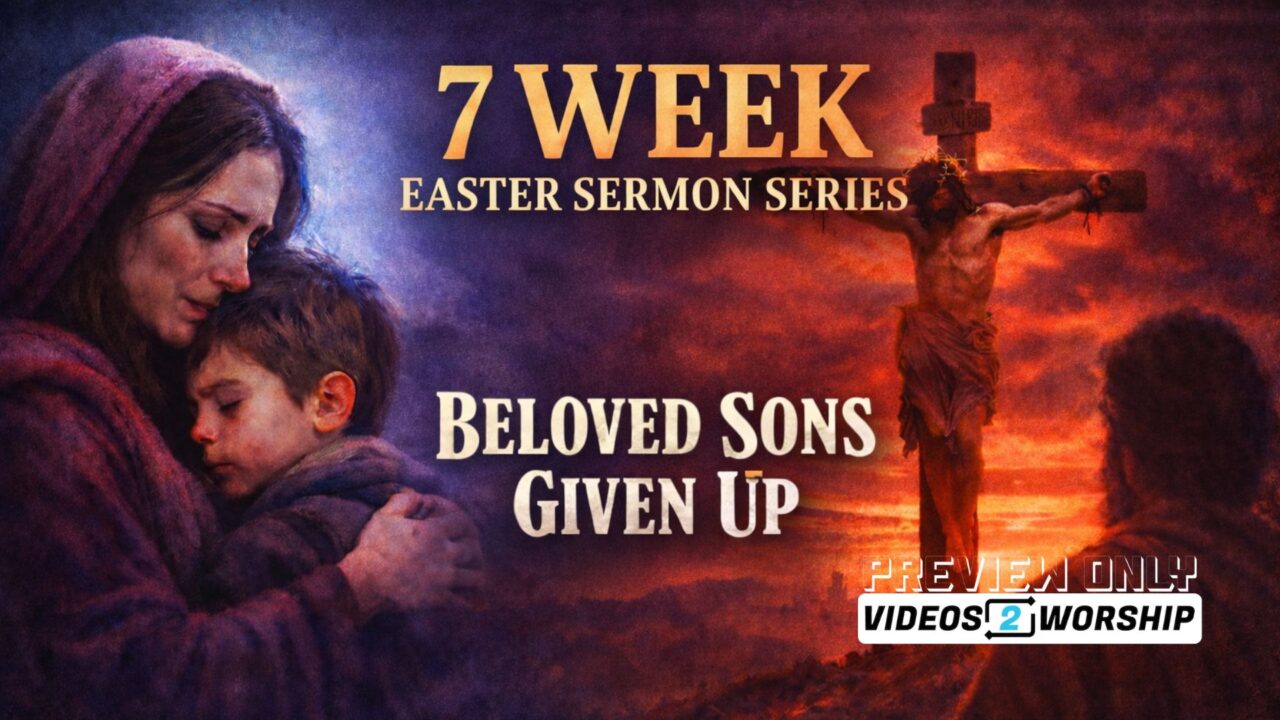
Some stories in Scripture appear once and stand alone. Others return again and again, not because they repeat themselves, but because they are training us to see something we would otherwise miss. One of those patterns is both unsettling and unmistakable: again and again, deliverance comes through surrender, and salvation is carried forward by a beloved son who is given up.
The pattern begins quietly, almost unbearably, with mothers who release what they love when there is no safe alternative left. It moves through worship that costs more than words can express. It descends into betrayal, testing, and death. Then it reaches a place no human parent could endure, where the Father gives up His Son without being spared. Only then does resurrection erupt, not as a sentimental ending, but as the decisive reversal of everything death claimed.
From Mothers to Father: Beloved Sons Given Up is a seven-sermon journey shaped around that biblical movement. It is designed to carry a congregation slowly and honestly from surrender to sacrifice to victory, without rushing past the weight of the story or softening its cost. Each sermon contributes to a single unfolding narrative, one that begins at the river and ends at the empty tomb.
The emotional progression is intentional. The series opens with desperate surrender, the kind that feels more like loss than faith. It deepens into costly worship, where blessing is offered back to God rather than clutched. It moves into the testing of faith and the brutality of betrayal, then settles into the inevitability of death. Good Friday stands as the unbearable center, where the pattern completes in the Son who is not spared. Easter follows, not as a change of mood, but as an explosion of life that proves surrender was never the end of the story.
A strong visual identity reinforces that journey. Lenten purples deepen as the weeks progress, visually carrying the congregation into darker emotional and theological territory. Good Friday shifts the palette to charcoal and black, allowing the gravity of the cross to remain unresolved. Easter arrives in brilliant whites and sunrise golds, signaling not only celebration, but triumph. The story has turned, and nothing is the same.
What unifies the series is not simply the repetition of sons across Scripture, but the way each story intensifies the question of what God is doing. Early on, sons are surrendered and preserved. As the series progresses, surrender gives way to sacrifice. The congregation begins to see that these earlier stories were never ends in themselves. They were preparation. They were prophecy. They were pointing toward a moment when the pattern would no longer stop short of death.
At that point in the journey, it helps to see the full arc laid out clearly.
SERIES OVERVIEW
| Sermon | Title | Primary Text | Core Movement | Emotional Beat | Visual Cue |
|---|---|---|---|---|---|
| 1 | Given to the River | Exodus 2:1–10 | Surrender that becomes deliverance | Desperate Surrender | Lenten purple, lighter tone |
| 2 | Given to the House of God | 1 Samuel 1–3 | Worship that multiplies blessing | Costly Worship | Deepening purple |
| 3 | Given to the Altar | Genesis 22:1–14 | Faith tested, the Lamb revealed | Testing Faith | Deep purple, increasing weight |
| 4 | Given to the Pit | Genesis 37; 50 | Betrayal turned into salvation | Brutal Betrayal | Shadowed purple |
| 5 | The Beloved Son Enters | Matthew 21:1–11 | All patterns converge | Inevitable Death | Darkest purple |
| 6 | The Son Not Spared | Romans 8:31–39 | The Father gives the Son | Unbearable Sacrifice | Charcoal and black |
| 7 | What Does Jesus Do When Facing Death? | Luke 7; John 11 | Death reversed, life victorious | Explosive Victory | White and sunrise gold |
The opening sermon, Given to the River, introduces the pattern in its rawest form. Jochebed cannot save Moses by holding him. She releases him to the Nile in an act that looks like loss but becomes the doorway to deliverance. The river that should have swallowed him becomes the path to the palace, and the child given up rises as a deliverer. Faith, in this story, is not control. It is surrender when control is gone.
Given to the House of God shifts the tone from desperation to worship. Hannah gives back the miracle she prayed for, not because God demands it, but because worship that costs nothing is not worship at all. The son she releases becomes the voice of God to a nation starving for truth. What was personal blessing becomes communal salvation.
In Given to the Altar, the pattern sharpens. Abraham is asked to give up Isaac, the beloved son. The question “Where is the lamb?” hangs over the entire sermon, pointing forward to a sacrifice still unseen. God provides a substitute, and Isaac is spared, but the story refuses to close comfortably. It leaves a promise echoing through Scripture: one day, on this mountain, God Himself will provide the Lamb.
Given to the Pit brings betrayal into the center of the narrative. Joseph is not surrendered in faith, but sold in hatred. Yet the pit becomes preparation, and the son given up rises to save the very ones who betrayed him. Evil does not become good, but it does become used. The story trains the congregation to recognize how God works through, not merely around, human sin.
The Beloved Son Enters brings all four threads together. Jesus rides into Jerusalem as the fulfillment of Moses, Samuel, Isaac, and Joseph. The crowd celebrates, but Jesus weeps. They want victory without sacrifice. He comes knowing He will not be spared. The parade moves inexorably toward the cross.
The Son Not Spared stands at the heart of the series. This time the pattern does not pause. The Father gives up His beloved Son fully and finally. The darkness is real. The cost is absolute. And the love of God is revealed not in restraint, but in self-giving.
Finally, What Does Jesus Do When Facing Death? answers the question the series has been building toward. Jesus does not explain death away. He enters it, confronts it, and reverses it. He raises the dead before His own resurrection, then walks out of the tomb Himself. The beloved Son given up is the beloved Son risen, and resurrection becomes the final word.
This series is designed for churches that want to walk the full road from surrender to resurrection without shortcuts. It honors the weight of Scripture, the cost of redemption, and the joy of Easter without separating them from one another. The result is not just a sequence of sermons, but a single, cohesive proclamation of the gospel.